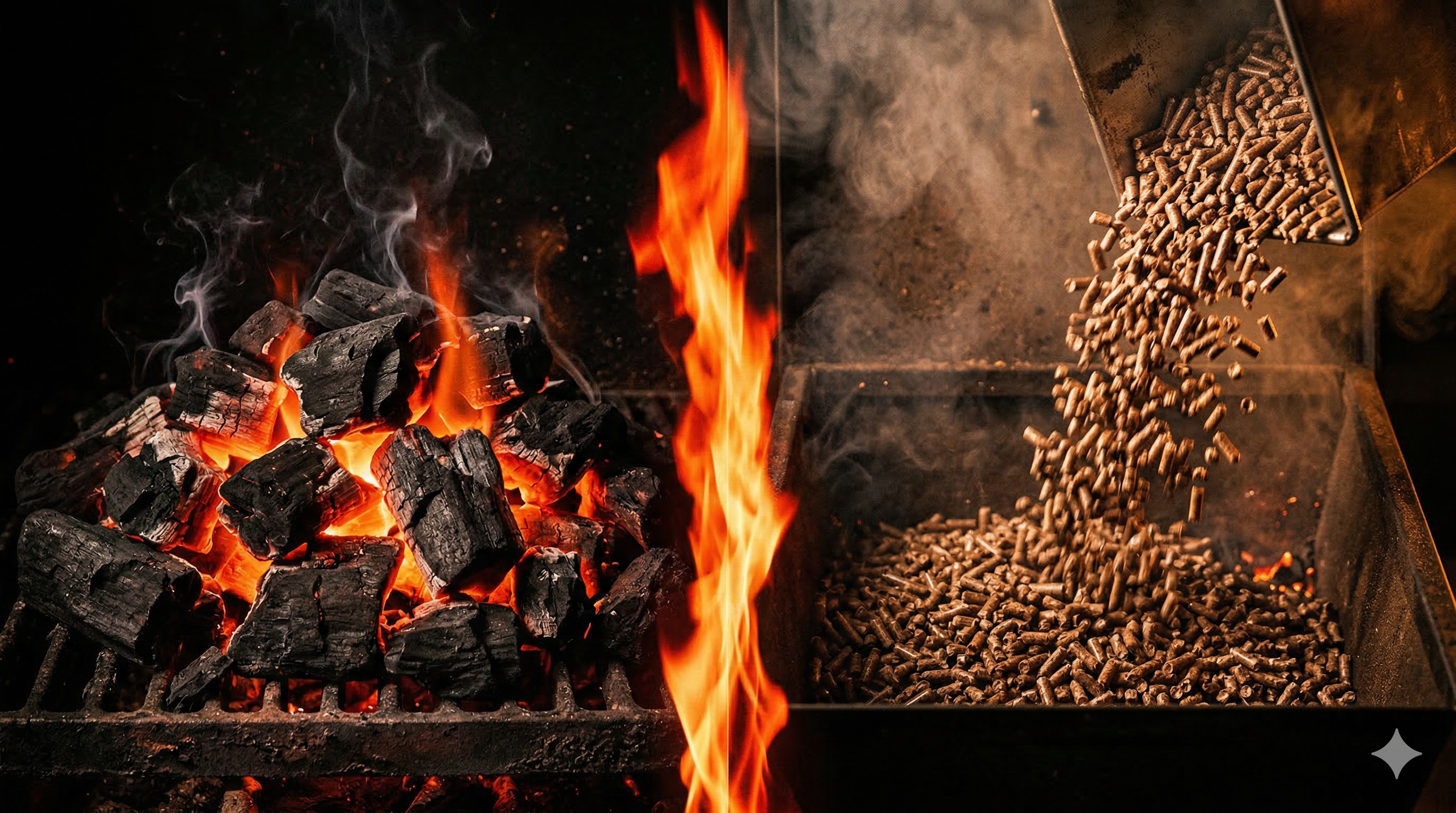
You can have the best smoker on the block and the most perfect brisket money can buy — but if you're burning the wrong fuel, you're leaving everything on the table. Or worse, you're leaving a weird taste on the meat.
Here at the Backyard Pitstop, we run two very different rigs, and they each demand a very different kind of fuel. The Pit Boss Laredo 1000 is a pellet smoker — she eats wood pellets and converts them into smoke and heat with mechanical precision. The Weber Kettle Original Premium is old school — pure charcoal, pure fire, pure feel. Choosing the right fuel for each isn't just a preference thing. It's the difference between a great cook and a legendary one.
Let's pop the hood and break it down.
🪵 Pellet Power: Pit Boss Competition Blend
If you've ever wondered why some backyard pitmasters swear by pellet grills, the answer usually starts with consistency. When you dial in 225°F on the Laredo 1000 and walk away, it holds that temp — and the fuel is a huge reason why. But not all pellets are created equal.
The Pit Boss Competition Blend is the go-to in the Laredo's hopper for good reason. It's a three-wood marriage of maple, hickory, and cherry that layers flavor beautifully without any single note overpowering the cook. Maple brings mild sweetness to the background. Hickory delivers that classic Southern smoke backbone. Cherry rounds it out with a subtle fruit note and helps give your bark a gorgeous reddish-mahogany color.
This is the kind of pellet blend that works across the board — brisket, pork butt, ribs, chicken. If you're just getting started with pellet cooking and want one bag to do it all, this is your pit crew chief.
⚠️ Why Pellet Quality Matters
There's a dirty secret in the pellet world: a lot of brands are cutting their product with filler wood — usually oak or alder — while still marketing it as "hickory" or "apple." The wood on the bag may only be 20–30% of what's actually in the pellet. Pit Boss uses a higher concentration of the labeled wood species, especially in their competition and hardwood lines, which means what you smell on the bag is closer to what you actually taste on the meat.
Pellet quality also directly affects your smoke output and temperature stability. Low-quality or high-moisture pellets burn inconsistently, clog your auger, and can even crack during storage — causing powder buildup in the hopper. Buy good pellets, store them sealed and dry, and your Laredo will reward you with clean, consistent smoke every single cook.
🔥 Pellet Pro Tips
- Store open bags of pellets in an airtight container — humidity is the enemy and will cause pellets to swell, crumble, and jam your auger.
- Don't mix different brand pellets in the hopper — inconsistent density can throw off your auger's feed rate and temperature control.
- For poultry, try going 100% cherry or apple for a lighter smoke profile — the Competition Blend can get assertive on a long chicken cook.
- Run the hopper down to near-empty before switching wood flavors to avoid blending profiles unintentionally.
- Darker pellets typically mean more flavor concentration — if your pellets look pale or powdery, the quality may be low.
🔥 Charcoal Character: Jealous Devil
If pellets are the reliable crew chief, charcoal is the wild card driver — unpredictable, dramatic, high-reward. And when you're working a Weber Kettle, you're playing a completely different game. You're not setting a temperature on a screen. You're managing airflow, coal positioning, and heat feel. The charcoal you choose is the biggest variable in that equation.
Jealous Devil is in a different weight class than your average big-box store charcoal. It's made from premium South American hardwood — primarily a species called Quebracho, which is one of the densest hardwoods on the planet. That density translates directly into heat — we're talking burns that can push well past 700°F for searing, with a long, even burn life that holds steady for hours.
The pieces are large, which means less small-chunk dust in the bag and a more predictable fire. It lights faster than briquettes, burns cleaner than most lump on the market, and produces a mild, neutral smoke that lets the food speak for itself — or lets you add your own wood chunks on top for flavor control.
⚖️ Lump vs. Briquettes: The Eternal Debate
The Weber Kettle can run both lump charcoal and briquettes, and plenty of backyard cooks swear by one or the other. Here's the honest take: lump is faster, hotter, and more responsive. Briquettes are more consistent and burn longer at a predictable rate. For a quick weeknight cook or searing — lump wins. For a low-and-slow indirect cook where you need stable temps for hours — briquettes have their place.
Jealous Devil's lump is actually one of the few that bridges that gap. The Quebracho density means it burns longer than typical lump without the chemical additives that briquettes rely on for uniformity. You get the best of both worlds: high heat capability AND a burn life that respects the cook.
🔥 Charcoal Pro Tips
- Use a chimney starter — never lighter fluid. Fluid leaves a petrochemical residue that you WILL taste on the meat. No exceptions.
- Let your coals reach full ash coverage (they'll look gray/orange all the way through) before starting your cook — typically 15–20 minutes in the chimney.
- For the Snake Method on long cooks, Jealous Devil's larger pieces can be tricky — break up any oversized chunks to ensure even contact and a consistent burn path.
- Add hardwood chunks (not chips) directly to the coals for smoke flavor — oak, hickory, or cherry pair excellently with the neutral base smoke of Jealous Devil.
- The bottom vent controls heat, the top vent controls moisture and smoke — learn these two dials and you've cracked the Kettle code.
📊 Side-by-Side: The Fuel Breakdown
| Category | Pit Boss Pellets | Jealous Devil Lump |
|---|---|---|
| Grill Type | Pellet smokers (Laredo 1000) | Charcoal grills & kettles |
| Flavor Profile | Maple, hickory & cherry blend — layered, versatile | Neutral hardwood base — lets wood chunks do the flavor work |
| Heat Range | 180°F–500°F (grill-dependent) | Up to 700°F+ sear capability |
| Burn Time | Continuous via auger-fed hopper | Long for lump — 2–4+ hours depending on setup |
| Temp Control | Set it and forget it (digital controller) | Manual — vent management and intuition |
| Smoke Output | Consistent TBS (thin blue smoke) at lower temps | Variable — controllable with vent and fuel management |
| Ash Production | Low — minimal cleanup | Very low for lump — another Jealous Devil win |
| Ease of Use | Beginner friendly | Skill-based — rewarding once mastered |
| Cost | Mid-range — roughly $1/lb | Premium lump — worth every dollar |
🏁 Which Fuel Wins? (Trick Question.)
Here's the deal — this isn't a competition. Both fuels are built for different machines and different moments. Asking whether pellets or charcoal is better is like asking whether a smoker or a kettle is better. They're different tools, and part of the fun of running both rigs is knowing when to reach for which one.
Fire up the Laredo on pellets when: you want precise temperature control, you're doing long smokes (brisket, pork butt, ribs), you're multitasking and need that set-it-and-forget-it reliability, or you want clean, delicate smoke on more subtle proteins like fish or poultry.
Roll with the Kettle and Jealous Devil when: you want maximum sear heat, you're doing something fast and hot (burgers, steaks, chops), you want to geek out on fire management and technique, or you just want that primal, hands-on charcoal experience that no digital controller can replicate.
At the Backyard Pitstop, the answer to "which should I use?" is almost always: what are you trying to accomplish today? Let the cook drive the decision, and let the fuel be the fuel. Neither Pit Boss pellets nor Jealous Devil charcoal will let you down when you put them in their home rig and treat the cook right.
Now go start something on fire. You've earned it. 🏁
Head to the recipe builder and find something worth firing up the pits for.
🔥 Try the Recipe Builder